Foundation Crack Repair Kit Review: Who It Fits and Who Should Skip It
We may earn a commission if you buy through links on this page, at no extra cost to you. It never changes what we recommend. How we make money.
Worth it for leaking vertical or diagonal cracks in poured concrete walls, up to 3/8" wide. Not for block walls, horizontal cracks or a wall that is moving.
A contractor typically charges $250 to $800 per crack. See the full cost comparison of DIY and pro repair.
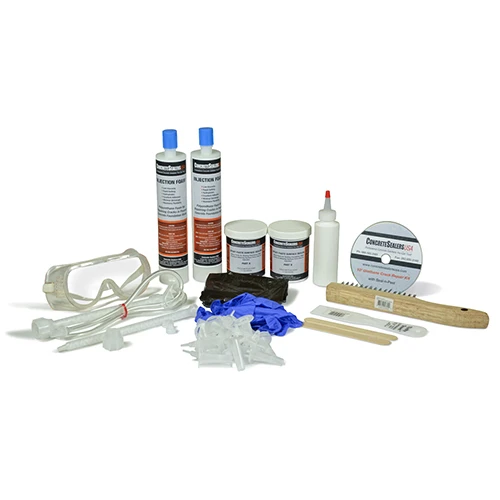
What is in the box?
| Injection foam | 2 cartridges of hydrophobic polyurethane, expands up to 20x |
|---|---|
| Surface seal | 2 jars of 2-part epoxy paste, 6 to 7 minute working time |
| Ports | 15 surface ports and caps |
| Tools | Trowel, wire brush, mixing tubes, hose with shut-off valve |
| Safety | 2 pairs of nitrile gloves, safety glasses, drop cloth |
| You add | A standard caulk gun |
Good fit if
- Water seeps through a crack when it rains
- The wall is poured concrete, not block
- The crack is vertical or diagonal and under 3/8"
- You are about to finish the basement
Skip it if
- The crack is horizontal or stair-step
- The wall bows or one side sticks out
- The wall is concrete block
- You need to add strength, not stop water
How does it work?
You glue the ports along the crack with the epoxy paste, then spread more paste over the crack face to seal it. After 2 to 3 hours, the manufacturer says the paste has set enough to inject. You push foam into the bottom port with a caulk gun until it shows at the next port, cap it, and work your way up.
The foam is hydrophobic, so it pushes water aside. Concrete Sealers USA says it expands up to 20 times its volume and stays flexible after it cures, so it moves with the wall instead of cracking. Beyond the caulk gun, here is what else is worth having on hand.
See every step in the DIY guideWhat are the pros?
- Foam stays flexible as the wall moves
- No drilling: ports glue to the surface
- Everything but the caulk gun is included
- Refill kits for more cracks
What are the cons?
- Epoxy paste needs a dry surface
- 2 to 3 hours before you can inject
- Leaves paste on the wall unless you grind it off
- Adds no structural strength
Which size do you need?
| Kit | Covers | Price | Best for |
|---|---|---|---|
| 10 ft, epoxy paste | About 10 ft | $204.95 | One or two cracks |
| 10 ft, peel-off sealer | About 10 ft | $239.95 | A clean wall afterwards |
| 30 ft, epoxy paste | About 30 ft | $574.95 | Finishing a whole basement |
| 30 ft, peel-off sealer | About 30 ft | $654.95 | Landlords and repeat jobs |
Prices from concretesealersusa.com on . They may change.
Questions
Do DIY foundation crack repair kits work?
Yes, for the right crack. A polyurethane injection kit can seal a leaking, non-structural crack up to 3/8" wide in a poured concrete wall. It will not fix a horizontal crack, a block wall or a bowing wall. The prep decides the result: the surface paste needs a clean, dry wall to seal. Read the full answer
Can you inject a foundation crack while it is wet?
Yes for the foam, no for the paste. Concrete Sealers USA says its foam adheres wet or dry, while its epoxy paste is not meant for wet surfaces. Wait for a dry spell, or dry the face of the wall, before you paste the ports on. Read the full answer
What do I need besides a foundation crack repair kit?
One tool: a standard caulk gun is the only tool the Concrete Sealers USA kit asks for. Most people also want a marker, a shop vacuum, rags, a work light, and a garden hose for testing the repair. The kit already includes gloves, safety glasses, a wire brush, a trowel, the ports and the paste. Read the full answer
Can you use a crack injection kit on a block wall?
No. Injection kits like the Concrete Sealers USA kit are made for poured concrete walls. A block wall has hollow cores, so foam can disappear into the gaps instead of filling the crack. Cracks in block walls, especially stair-step or horizontal ones, should be checked by a structural engineer first. Read the full answer